Jump to product information
1 by 3
Sold Out

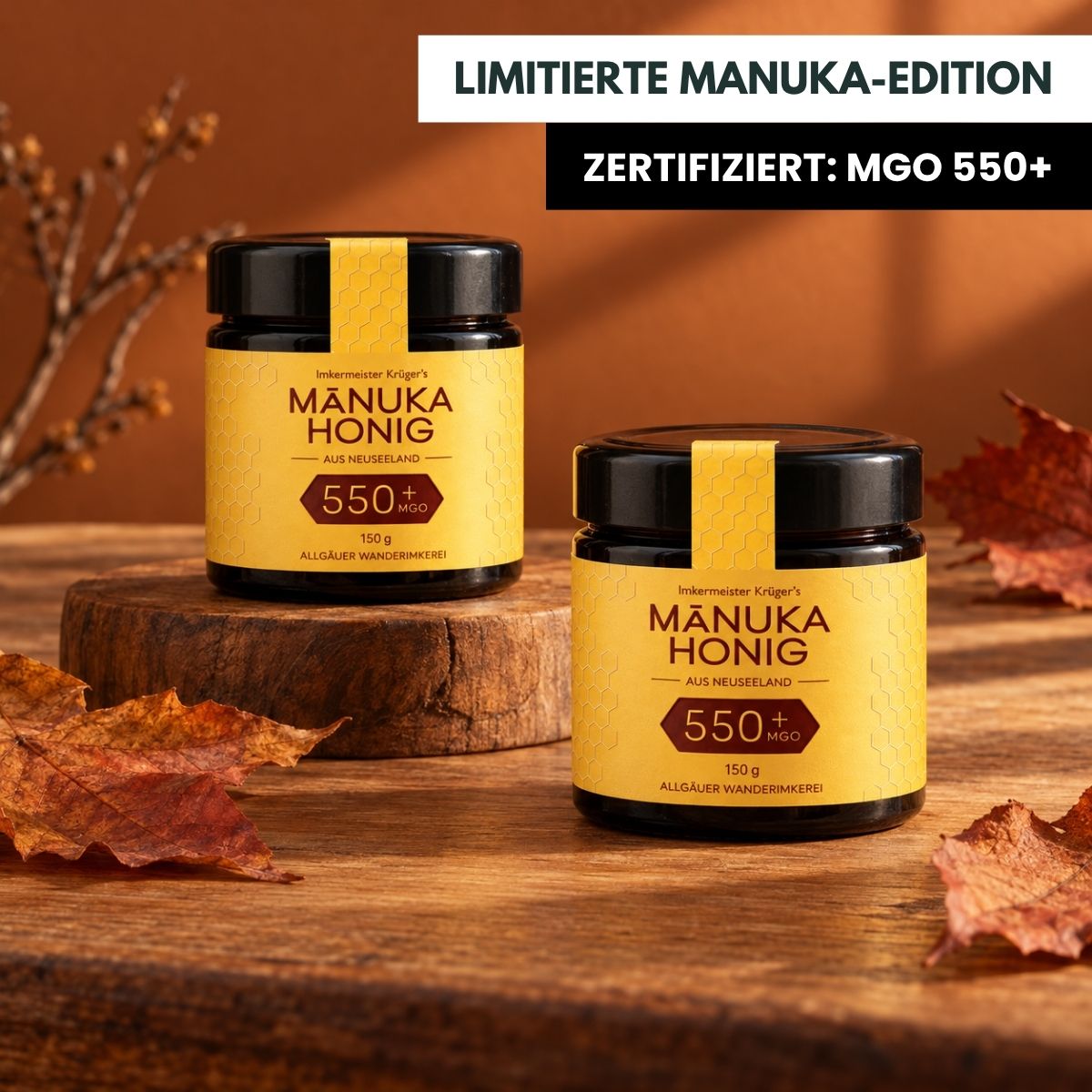
Allgäuer Wanderimkerei Manuka Honey MGO 550+ – from New Zealand, 150 g

MGO 550+: at least 550 mg of methylglyoxal per kilogram, certified
Lab-tested twice: every batch analysed in New Zealand and in Germany
Traceable: batch number on the lid, analyses available online
PayPal payment icon Klarna payment icon Visa payment icon Mastercard payment icon Apple Pay payment icon Google Pay payment icon Twint payment icon
Show full details

MGO rating

What does MGO 550+ mean?

MGO stands for methylglyoxal, a compound that occurs naturally in manuka honey. It forms as the honey matures, from dihydroxyacetone contained in the nectar of the manuka flower (Leptospermum scoparium). The number states the minimum milligrams of methylglyoxal per kilogram of honey. MGO 550+ therefore means at least 550 mg per kilogram.

The MGO rating is the most important way to tell genuine manuka honey from ordinary blossom honey. Because manuka honey is expensive, it is regularly counterfeited or diluted. What matters is that the value is verified in a laboratory for every batch rather than just printed on the label.

Comparison: Our Products and Standard Preparations
Manuka Honey MGO 550+ – from New Zealand, 150 g
Manuka honey without batch verification
Origin:
Bay of Islands, New Zealand, one family apiary
Often just “New Zealand”
MGO content:
At least 550 mg/kg, certified
Stated without a batch certificate
Lab testing:
Twice: New Zealand and Germany
Not disclosed
Traceability:
Batch number, analyses online
Usually none
Packaging:
Light-protecting amber glass
Often clear glass or plastic
Ingredients:
100% manuka honey, no additives
Purity often not documented

Information about Manuka Honey MGO 550+ – from New Zealand, 150 g

About the product

Origin: Bay of Islands, New Zealand

The manuka plant is a shrub native mainly to New Zealand. This honey comes from the Bay of Islands in the north of the North Island, where a family-run apiary produces it. There is no middleman between beekeeper and bottler: the Allgäuer Wanderimkerei works directly with the beekeeper, has every harvest tested and fills it in Germany.

Why double lab testing matters

Because of its high price, manuka honey is regularly counterfeited or blended with other honey. That is why every batch is analysed twice, independently, once in New Zealand and once in Germany. The results can be viewed using the batch number on the lid: scan the QR code on the back, enter the number, done.

Taste and texture

Despite its high MGO rating, this honey has no harsh edge. It is creamy, golden to yellowish and tastes rich and aromatic, with a mild sweetness and hints of caramel and malt. That makes it a good place to start if you are trying manuka honey for the first time. As with any natural product, colour, aroma and texture may vary slightly from batch to batch.

Frequently Asked Questions (FAQ)

What does MGO 550+ mean?

At least 550 mg of methylglyoxal per kilogram of honey. The value is lab-tested and certified for every batch.

Where does the manuka honey come from?

From the Bay of Islands in the north of New Zealand, from a family-run apiary. It is filled in the Allgäu region of Germany.

How can I check that the honey is genuine?

Every batch is analysed in a laboratory in New Zealand and in Germany. Using the QR code on the back and the batch number on the lid, you can view the analysis results for your own jar.

Is the manuka honey 100% pure?

Yes. It consists solely of New Zealand manuka honey, with no other additives.

What does manuka honey MGO 550+ taste like?

Rich and aromatic, with a mild sweetness and notes of caramel and malt. It is less harsh than many other manuka honeys and makes a good introduction.

What is the difference between MGO and UMF?

Both are grading systems for manuka honey. MGO states the measured methylglyoxal content directly in mg/kg. UMF is a quality mark of the UMF Honey Association in New Zealand that tests further markers such as leptosperin and dihydroxyacetone alongside methylglyoxal. This honey is graded by MGO.

How do you use manuka honey?

Straight from the spoon, in tea that has cooled a little, on bread, in yoghurt or porridge. Many people prefer it pure, a teaspoon slowly on the tongue.

From what age is manuka honey suitable?

Like all honey, from the age of one. Children under 12 months should not eat honey.

How should manuka honey be stored?

At room temperature away from light. The amber glass already protects the honey from light. The best-before date and batch number are on the lid.

Raw Animal nutrition guide as a PDF on a tablet

We take your health seriously

We are all unique, and we each have our own health goals.

We have tried to cover most of the health concerns in our society and have identified the following key areas:

  • More energy & less exhaustion in daily life
  • Become stronger, more resilient, and more capable
  • Bring skin, hair, and nails to a natural glow
  • Balance digestion & gut health
  • Strengthen the immune system naturally
  • Improve hormones, libido & vitality
  • Targeted nourishment for bones, joints, and connective tissue

Based on this, we have created a free 25-30 page PDF guide for each topic just for you. No gimmicks, just real, valuable, and effective tips and tricks.

Now to the guide form
Manuka Honey MGO 550+ – from New Zealand, 150 g
€30,00